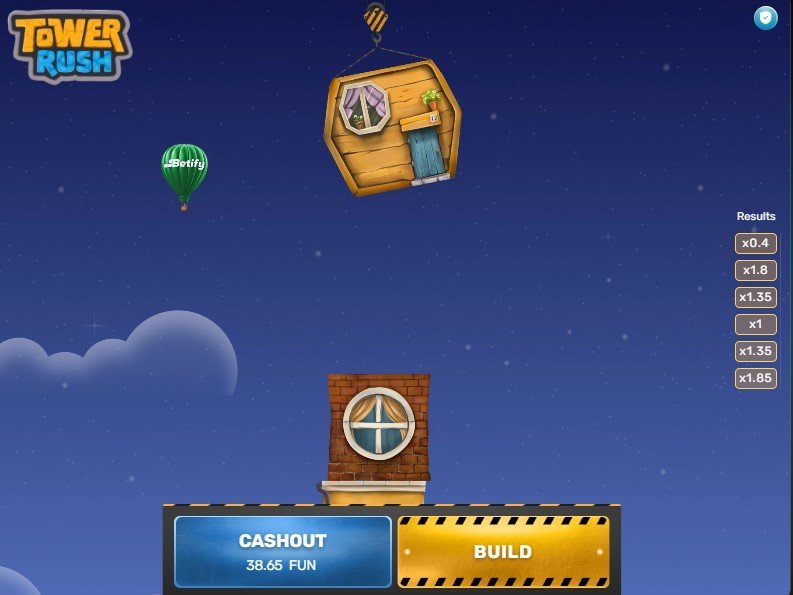
Tower Rush - Guide and Functionality
The first thing you notice when launching Tower Rush, even before understanding the multipliers or bonuses, is the simplicity of the concept. A block falls, you click, it lands. If the placement holds, the tower rises. If the block overextends, everything collapses.
Behind this streamlined mechanic lies a crash game more subtle than it seems. Galaxsys has built a game where timing is paramount, and where two modes coexist: a free demo version that allows you to play without spending a dime, and a real money version that turns every click into a financial decision.
This article details how the game works, explores what the demo concretely offers, and lays the groundwork for those considering switching to real stakes.
The demo version: much more than a tutorial
Tower Rush offers a demo mode accessible without registration on most platforms. You launch the game, virtual credits are automatically allocated, and the game begins. Same interface, same speeds, same bonuses. The only difference: no real money at stake.
Many players see the demo as a simple warm-up. A few rounds to "get the hang of it," then it’s off to the paid mode. In practice, the demo serves a much greater purpose.
Calibrating your personal cashout threshold
Each player has a different tipping point. For some, concentration wanes after the eighth floor. For others, the stress only kicks in from the twelfth. The demo allows you to identify this threshold without financial consequences.
Over a series of 20 to 30 free rounds, trends emerge. You can spot the floors where placement becomes hesitant, the moments when reflexes slow down. This personal diagnosis is invaluable once you switch to real money.
Observing bonus behavior
The three bonuses in the game (Frozen Floor, Temple Floor, Triple Build) also appear in the demo. Their functionality remains the same. Testing different reactions to a Frozen Floor, for example, helps decide whether to continue climbing after activation or to cash out immediately.
In free mode, you can afford to take the risky option. Continue after a Temple Floor to see how high it goes. Ignore a Triple Build and try manually. These tests provide a personal database that the paid mode does not allow you to build without cost.
Feeling the platform's latency
A rarely mentioned point: the demo allows you to measure the game's response time on a given casino. Tower Rush relies on millimeter timing. If the platform shows a slight delay between the click and the block placement, it changes everything. It's better to discover this detail in free mode than in the middle of a series of €5 bets.
How a round works, step by step
Before starting anything, the player sets their bet. On Tower Rush, the range goes from €0.10 to €100. Once the amount is chosen, you press BUILD and the round begins.
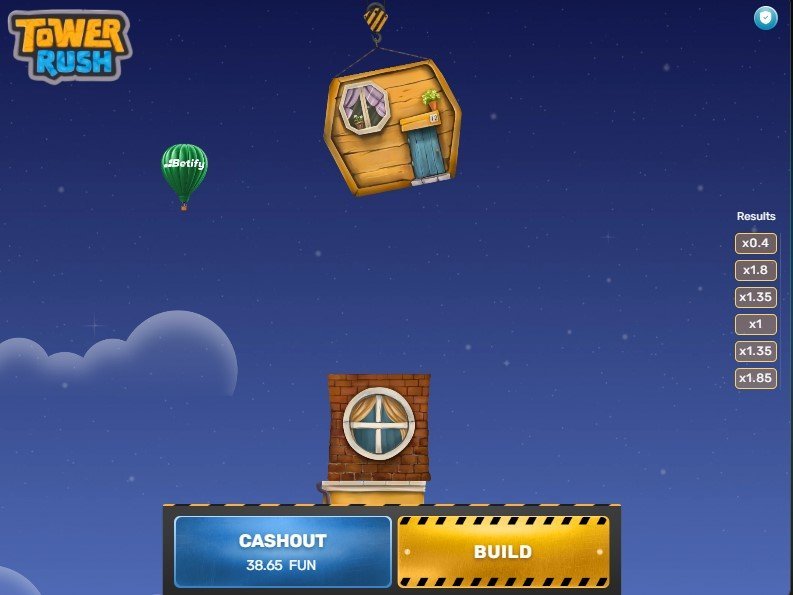
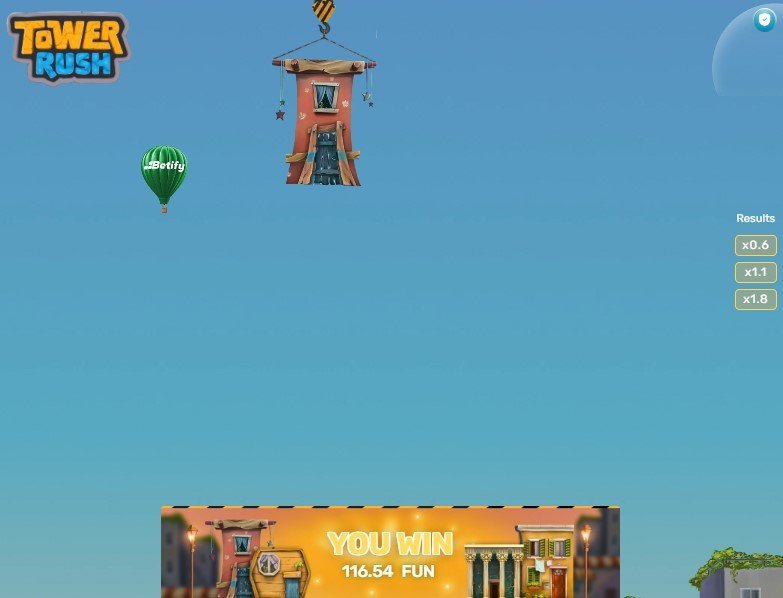
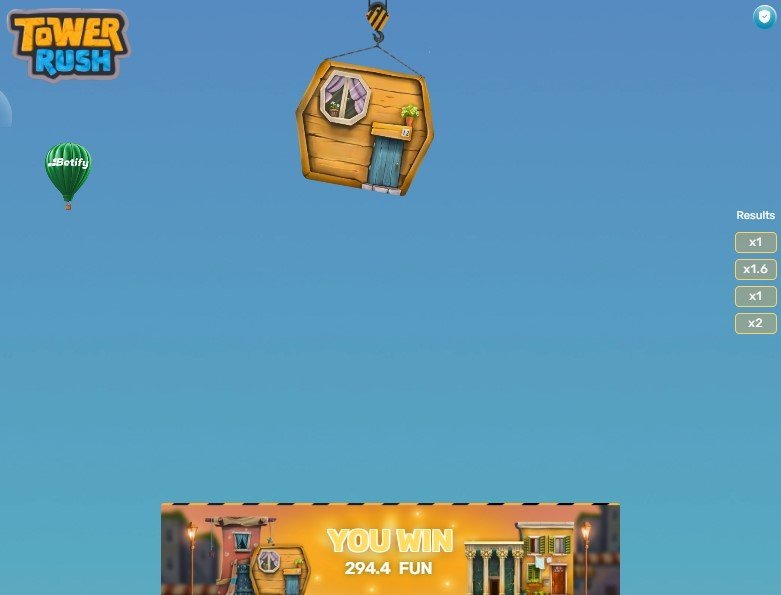
A block appears at the top of the screen, suspended from a crane. It swings left to right above the existing tower. The player waits for the right moment and releases. The block descends vertically.
Two possible outcomes.
First: the alignment is correct. The block stabilizes, a new floor is added to the tower, and the multiplier increases. Second: the block overflows too much. The structure loses balance and collapses. Round over.
The pace changes with the height. The first three or four floors provide a comfortable placement window. You have time to observe the movement, to anticipate the trajectory. From the fifth or sixth floor onwards, the oscillations tighten. The lateral movement accelerates, the contact surface decreases, and every millimeter of difference weighs more heavily.
Beyond the tenth floor, you enter a zone where the slightest inaccuracy can tip everything over. The difficulty does not progress in sudden jumps: it slides, almost imperceptibly, round after round.
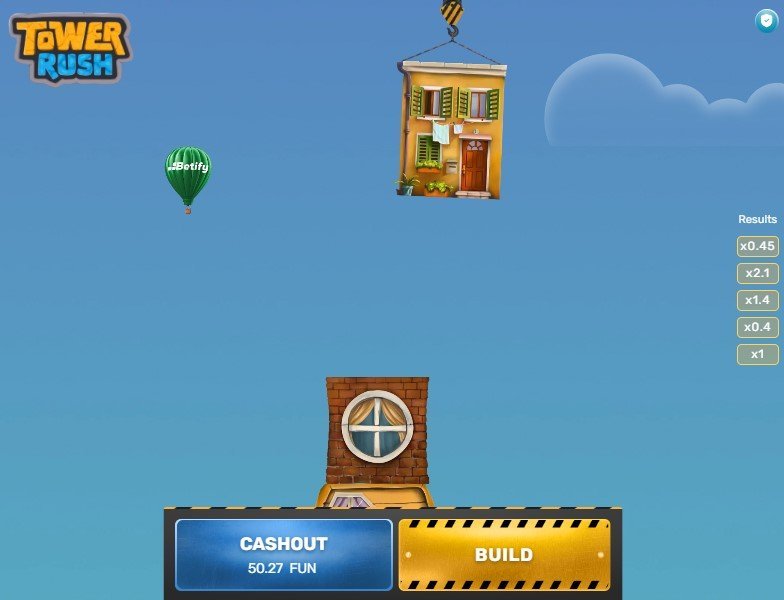
The CASHOUT button remains active throughout the construction. Pressing it ends the round and credits the winnings corresponding to the reached multiplier. No one forces the player to continue. This constant freedom to exit is at the heart of the gameplay.
How bonuses work in both modes
The three bonuses of Tower Rush appear randomly during construction. Their presence depends neither on the amount wagered nor on the chosen mode (demo or real money). The RNG decides.
Frozen Floorlocks in the current multiplier. If the tower reaches x14 at the time of activation, this amount becomes the guaranteed floor. Even if everything collapses three floors later, the player leaves with at least the fixed value. In real money, this bonus radically changes the risk calculation: once activated, attempting bolder placements no longer risks the entire bet.
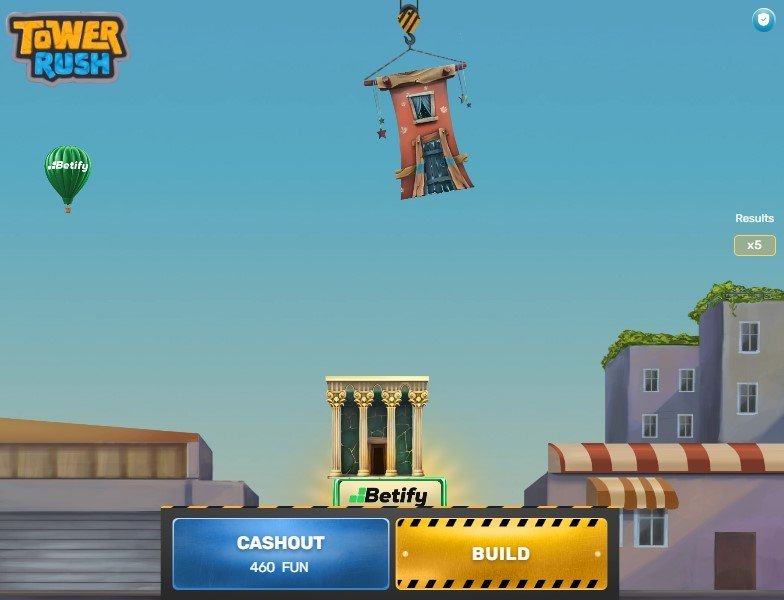
Temple Floorspins a wheel with several possible multipliers. The result is random. Sometimes a small boost, sometimes a significant jump. The trick that some players apply: cash out right after a good Temple Floor rather than continuing to climb.
Triple Buildautomatically stacks three floors without intervention. The multiplier increases by three levels at once, with no risk of poor placement. Mathematically, this bonus offers the best expected value of the three.
In demo mode, testing the three post-bonus scenarios (cash out immediately, continue cautiously, push all the way) gives a clear idea of what works for you.
Frozen Floor
Freezes a floor and prevents destruction. A temporary shield to protect your winnings.
Temple Floor
Golden floor with bonus multiplier. Significantly increases your potential winnings.
Triple Build
Place 3 blocks simultaneously for accelerated building and controlled risk.
RTP explained without jargon
RTP stands for Return To Player, or payout rate. Tower Rush has an RTP of 96.12% to 97%. In practical terms, over a very large number of games, the game returns between 96.12 and 97 cents for every euro wagered.
Two clarifications to avoid misunderstandings.
The first: this rate is calculated over millions of rounds. In a 30-minute session, the individual result can be well above or well below 97%. The game's variance is high. A player might double their bet over 5 rounds and then see their tower collapse 8 times in a row. The RTP does not predict the outcome of a session.
The second: the remaining share (3 to 4%) corresponds to the casino's edge. In the long run, the platform is mathematically profitable. Tower Rush is no exception to this rule. Understanding this from the start helps approach the game as entertainment, not as a source of income.
To place Tower Rush in relation to the market: many slot machines hover around 94-95%. Crash games generally rank higher, and Tower Rush positions itself at the top of that range.
Managing your budget between demo and real money
Player feedback on the demo and transitioning to real money
"Sophie, Lyon — February 2026** ⭐⭐⭐⭐ (4/5) I played three evenings in demo mode before depositing €15. Without this training phase, I would have probably messed up the timing on floors 7 and 8. The free mode taught me where I was struggling."
"Yannick, Rennes — March 2026** ⭐⭐⭐⭐⭐ (4.5/5) What struck me when going real was the tension at levels 10-12. In demo, I was comfortably going up to x15. With money on the line, I started cashing out at x6. And honestly, my sessions are much more consistent."
"Thomas, Nice — January 2026** ⭐⭐⭐⭐ (4/5) The Frozen Floor changes everything. In demo, I was testing crazy climbs after its activation. In real play, I'm more measured, but knowing that the floor win is guaranteed allows me to breathe."
"Élodie, Clermont-Ferrand — March 2026** ⭐⭐⭐⭐ (4/5) My mistake at the beginning: I skipped the demo. As a result, my first five rounds in real play were disastrous because I didn't understand the speed of the block starting from level 5. Fifteen minutes of demo would have been enough."
Frequently Asked Questions
Yes. The random number generator is identical in both modes. The speeds, bonuses, and multipliers work the same way.
No. Virtual credits have no monetary value. Only the real money mode allows for withdrawable winnings.
The minimum deposit depends on the casino (generally €10 to €15). The minimum bet on Tower Rush is €0.10 per round.
The bonus distribution system is governed by the same algorithm. The frequency of appearance does not change between the two modes.
In most casinos, no. The demo mode launches directly from the game page, without registration.
No. Cashout is exclusively manual. The player must click themselves to cash out. This lack of automation is part of the game's identity. ---
Our overall opinion — 4.2/5
Tower Rush draws its strength from a clear concept and a straightforward execution. The free demo provides a training ground that faithfully reproduces the paid game, which is rare enough to be noted. Transitioning to real money does not change the mechanics, only the pressure felt.
Strengths: a competitive RTP (96.12 to 97%), three bonuses that enrich sessions without complicating them, and a manual cashout that keeps the player on constant alert.
Limitations: visual repetitiveness during long sessions, the absence of auto-cashout which may frustrate some players, and tactile difficulty on mobile for high levels.
For those hesitating between demo and real money, the answer is simple: start with the demo. Always.
Rating: 4.2 / 5⭐⭐⭐⭐
Moving to real money: what changes (and what doesn’t)
The gameplay remains strictly the same
No hidden levels, no extra bonuses, no different speed. The same certified RNG manages both modes. The physics of the blocks doesn’t change a pixel.
2.
What changes happens in the player's mind.
In demo mode, missing a level at x18 results in a shrug.
In real money mode, with €10 at stake, the same failure creates a very different tension. The reflex to immediately re-bet to "make up for it" emerges, and it’s precisely this reflex that can be costly.
4.
Transitioning to the paid mode involves a few concrete steps:
Choose a licensed casino that offers Tower Rush
MGA or Curaçao licenses, check the footer of the site. Create an account. Email, password, personal information. Maximum five minutes. Deposit funds. Visa, Mastercard, e-wallets (Skrill, Neteller), crypto on certain platforms. The minimum is around €10 to €15. Complete KYC before playing. Not mandatory for depositing, but essential for withdrawing. Sending documents right after registration saves time.
What a realistic session looks like
A round of Tower Rush lasts between 15 seconds and two minutes. A typical 20-minute session represents about 15 to 25 rounds, depending on the playing style.
Let’s take a concrete example. Session budget: €20. Bet per round: €1.
Over 20 rounds, some games end as early as the second or third level (quick end of round, no win). Others climb up to x6, x10, sometimes more if a bonus appears. The final result depends on when the player cashes out and the frequency of early round endings.
With a systematic cashout around x4 to x6, most sessions fluctuate between -€5 and +€10 compared to the initial budget. Nothing spectacular, but a sustainable pace. Aiming for x20 or x30 each round produces much more volatile results: either the session skyrockets, or the budget evaporates in minutes.
The choice between these two approaches is made in demo mode. Not in real money.
Tower Rush on mobile: demo and real money are the same battle
Stay within limits
“Tower Rush goes by quickly. The rounds keep coming, the mechanics are addictive, and the line between 'just one more' and 'I've exceeded my budget' is crossed without warning.”
★★★★★
A few useful safeguards:
The game relies on a RNG. The mathematical advantage remains on the casino's side. Playing Tower Rush, whether in demo or real money, is purely for entertainment.
Players Info Service: 0 974 75 13 13.